
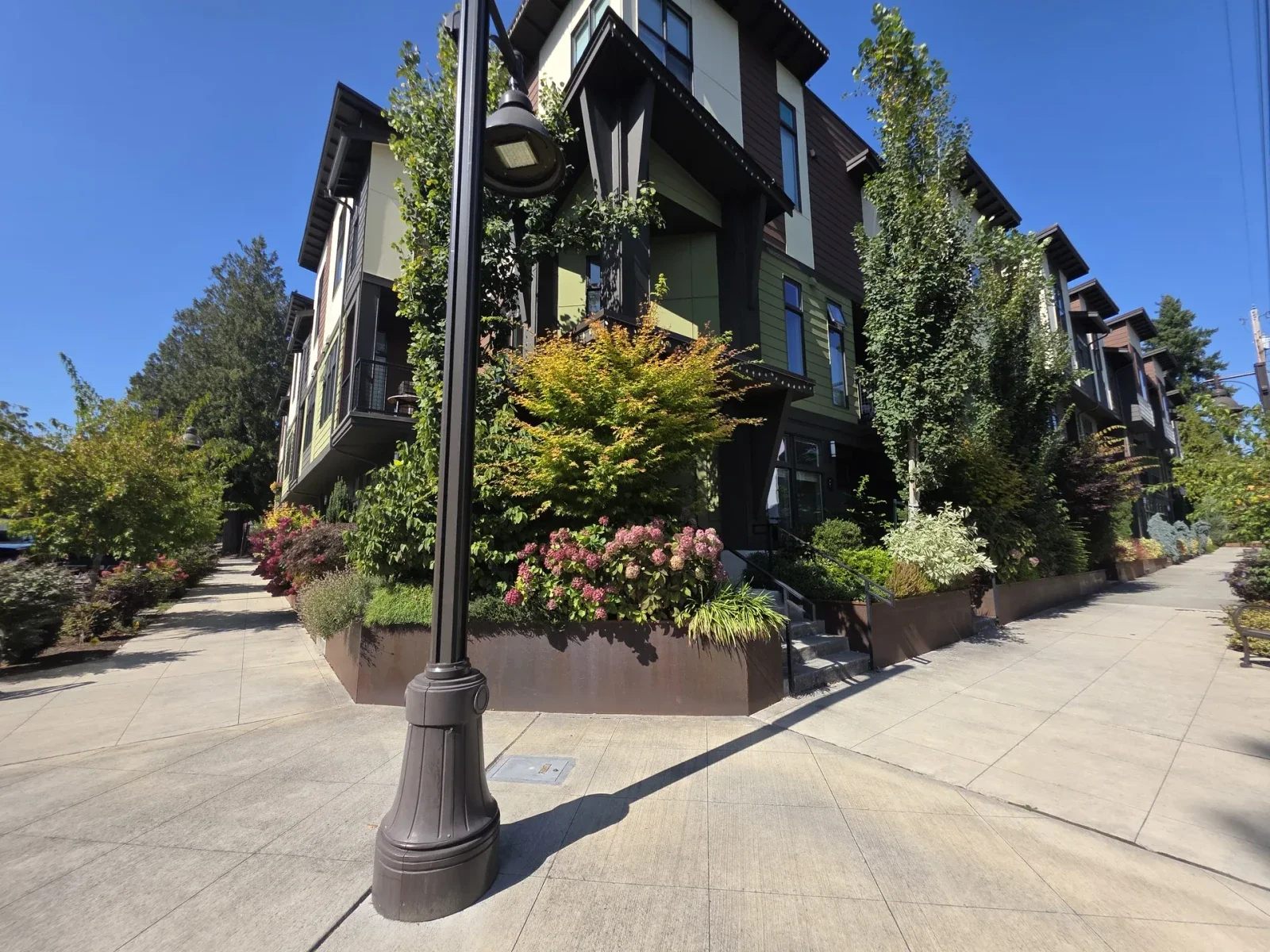
A planter is a raised container holding soil above grade with a defined edge. On Seattle properties they earn their place by controlling the soil conditions, keeping mulch off the paving, and adding planting depth where the native ground is compacted clay.
They also fail here more often than anywhere else, and almost always for the same reason.
Drainage is the whole problem
Seattle averages around 39 inches of rain a year. A planter that traps water holds roots in a saturated zone until they suffocate. Every planter we build gets real outlets at the base, routed so the water leaves somewhere useful rather than staining the paving in front of it.
One myth worth killing: a gravel layer at the bottom of a planter does not improve drainage. Water perches above the coarse layer instead of moving through it, which leaves a permanently wet band exactly where the roots sit. Outlets drain a planter. Gravel does not.
The growing medium matters too. Garden soil compacts in a container and stops draining. Planters need a container-grade mix that holds structure and keeps air in the root zone.
What they solve
Clean edges. Soil and mulch stay contained rather than washing across pavers in a storm, which cuts the cleanup at entries and walkways every winter.
Depth where there is none. Planting over compacted ground, over a slab, or against a building where the soil is builder’s rubble.
Definition. A planter marks an entry, frames a patio or separates a seating area without a fence.
Height. Planting brought up to eye level or to sitting height, which changes how a small space reads and makes the tending easier on your back.
Materials
Stone and block for permanence and mass. Cedar for warmth and a lower cost, with the same drainage detailing and a liner that lets the timber breathe. Concrete and fiberglass for contemporary settings and where weight is a constraint.
Built-in planters usually arrive as part of a wider patio or wall project, because the structure and the drainage want to be resolved at the same time.
Common questions
Why do planters fail here?
Water. Seattle gets around 39 inches of rain a year. A planter with no working outlet holds it, roots lose oxygen, and the planting declines within a season or two.
Does a gravel layer at the bottom help drainage?
No, and this is a persistent myth. Water perches above a coarse layer rather than moving through it, which leaves a saturated zone right where the roots are. Outlets are what drain a planter.
What materials do you use?
Stone, block, cedar, concrete and fiberglass. The choice follows the setting, the depth you need and how much weight the location can carry.
Can planters go on a deck or roof?
Sometimes, and weight is the constraint. Saturated soil is heavy, so that needs checking against the structure before anything is built.