
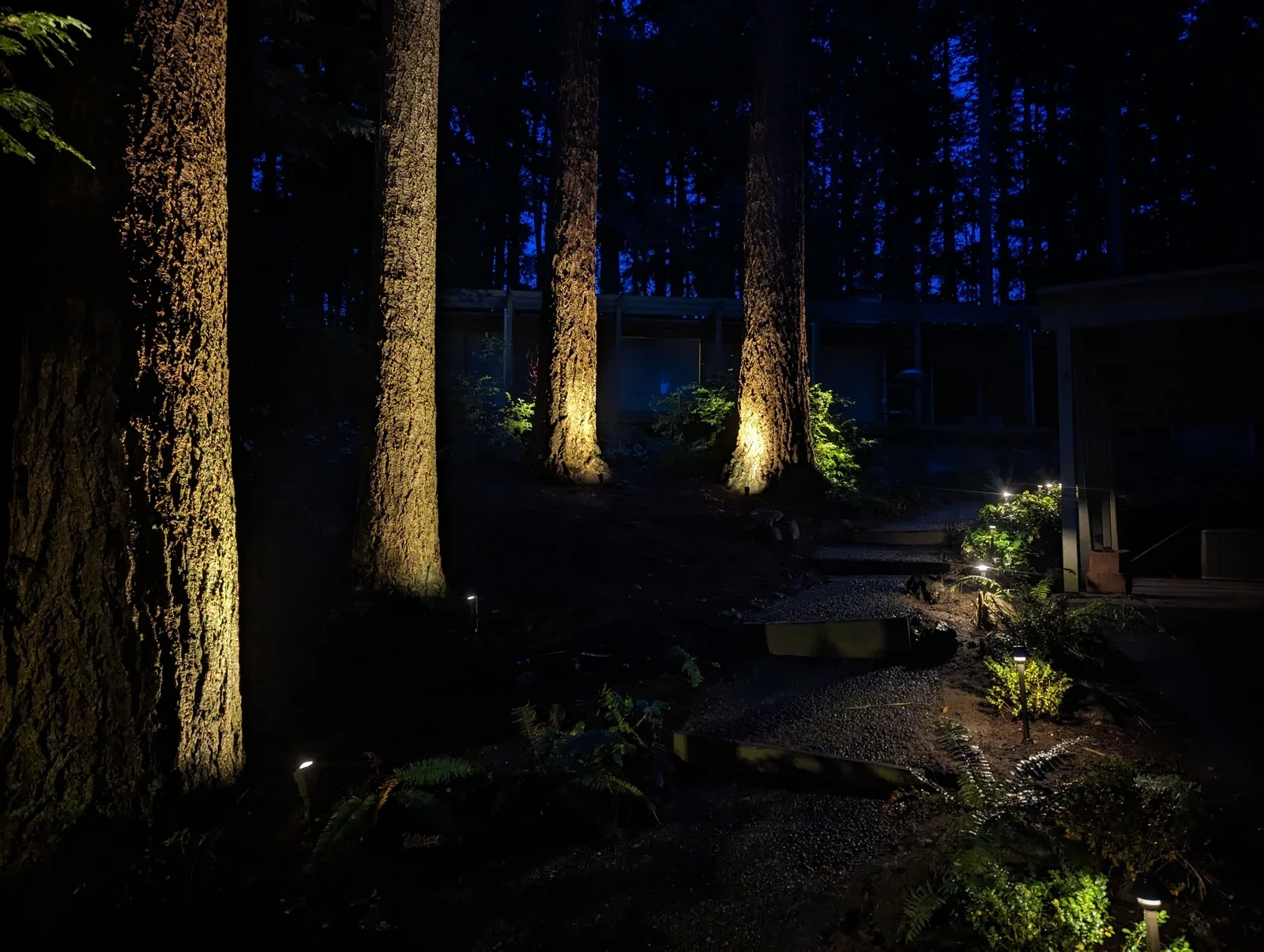
Seattle goes dark at half past four in December. For a good part of the year, the only version of a garden anybody sees on a weekday is the lit one, and a landscape with no lighting simply disappears for five months.
Low voltage lighting runs at 12 volts through a transformer. That makes it safe to install around beds, water and foot traffic, cheap to run on LED fixtures, and straightforward to extend later.
Light fewer things
The most common mistake is lighting everything. Even illumination flattens a garden into a wall of brightness and leaves nowhere for the eye to go. Picking a small number of things worth seeing, and leaving the rest dark, is what produces depth.
- Path and step lighting for the routes people actually walk after dark. Low, spaced, aimed down. Bright enough to place your feet and no brighter.
- Uplighting on a specimen tree, a wall face or a piece of stonework. One or two per garden, not one per plant.
- Down lighting from a tree or a structure, which reads as moonlight and is the most natural effect available outdoors.
- Grazing across a textured surface such as a drystack wall, which is the only way that stonework reads at night.
Built for a wet climate
Fixtures are rated for wet conditions and connections are sealed properly. Cheap push-on connectors are the usual failure point in this climate, not the fixtures themselves. Runs are buried at a sensible depth and mapped, so a future planting job does not put a spade through the cable.
Transformers are sized with headroom, because a lighting plan that is exactly at capacity cannot be extended when you want two more fixtures next year.
Lighting a landscape we built
Where we have done the design and build, lighting goes in as part of the same project and the cable routes are set before the hard surfaces go down. Retrofitting into a finished landscape is entirely possible, it just involves more careful trenching around what is already planted.
Common questions
Why low voltage?
It runs at 12 volts, which is safe to install around beds, water and foot traffic without conduit or a licensed electrical run for every fixture. It also draws very little power.
Do I need a permit?
Not usually. Most residential low voltage lighting does not require one. The transformer needs a suitable outdoor outlet, which sometimes does.
Will fixtures survive the winter here?
Yes, when they are rated for wet conditions and the connections are properly sealed. Cheap connectors are the usual point of failure, not the fixtures.
How many fixtures does a garden need?
Fewer than most people expect. Lighting everything flattens a garden. Picking a handful of things worth seeing gives you depth.