
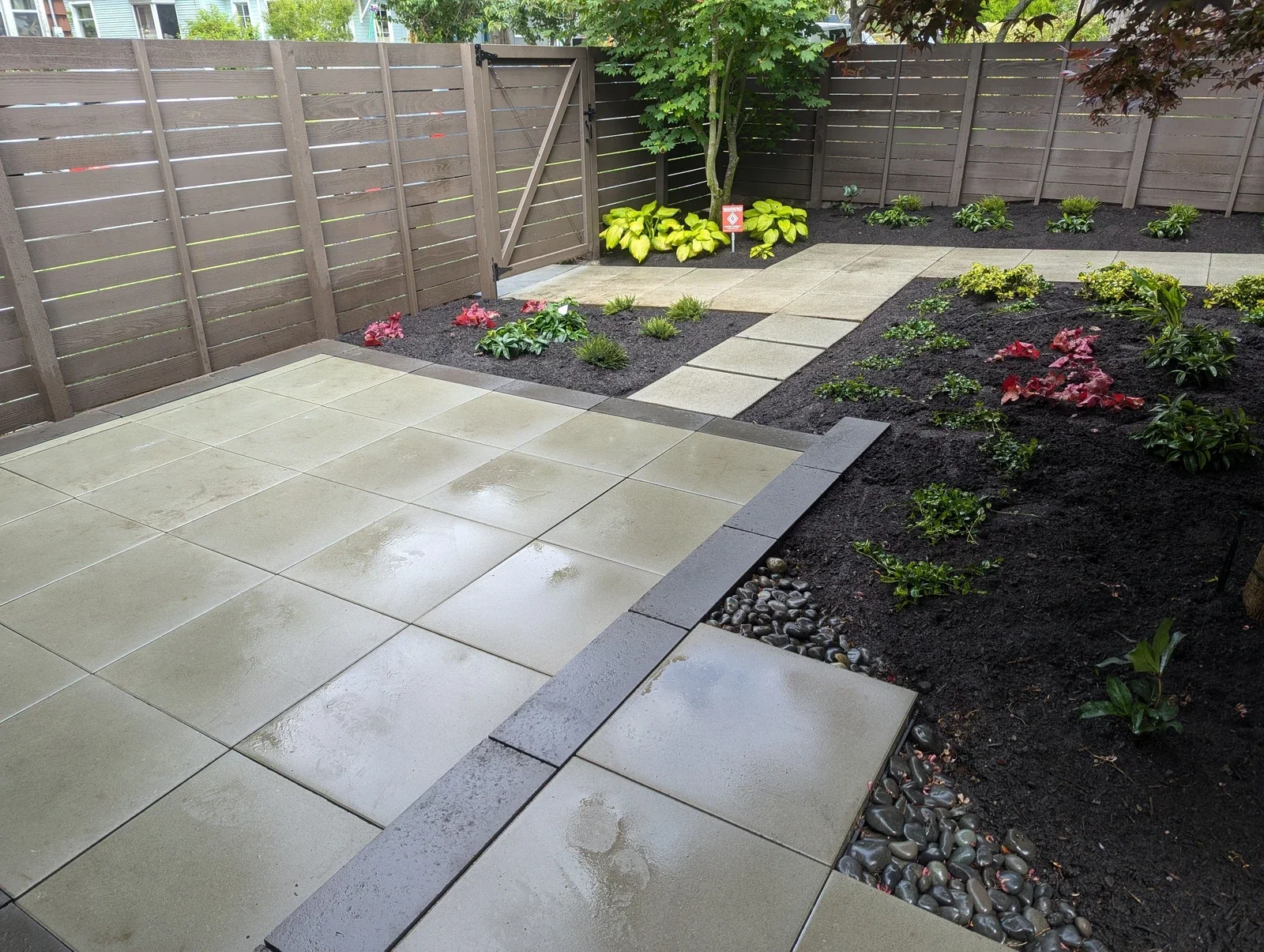
Almost every failed patio in this region failed underneath. The stone was fine. The base was not deep enough, or it was not compacted, or water had nowhere to go and lifted the whole surface the first winter it sat saturated. A patio here is a drainage project with a nice finish on top.
We build the base for the ground it is actually sitting on, which on a Seattle lot is frequently clay that holds water. That means excavation to a real depth, compacted aggregate in lifts rather than one dumped layer, and a plan for where water leaves before the first stone is set.
What we build
Patios. Paver, flagstone and natural stone, sized to the furniture and the way the space gets used rather than to the widest available rectangle.
Walkways and paths. Routes people will actually take. A path that ignores the desire line grows a dirt track beside it within a season.
Steps. Rise and run matter as much as material. Steps that are slightly too tall or slightly too shallow are felt on every single trip up them, and they are the part of a build people notice for years without being able to say why.
Edging and borders. The line that keeps a surface from migrating into a bed.
How the work runs
- Excavation and grading. Down to a depth suited to the soil and the load, with the finished grade falling away from the house.
- Base. Compacted aggregate in lifts. This is the part nobody sees and the part that decides whether the patio is still flat in year eight.
- Setting bed and surface. Stone or paver laid to the pattern in the plan, cuts made on site.
- Joints and edge restraint. Polymeric sand or the appropriate joint fill, edges restrained so the field cannot creep.
- Finish grade and planting. Beds brought back up to the new surface so the hard edge sits into the landscape rather than on top of it.
Drainage is designed into the grade as part of this work, not bolted on afterward. Where a property has a standing water problem, that gets solved first. See drainage and French drains.
Common questions
What makes a patio fail here?
Almost always the base. A surface set on too little compacted material will move once it has been through a wet winter and a freeze, no matter how good the stone is.
Pavers or flagstone?
Pavers give a tighter, more uniform surface and are easier to lift and reset later. Flagstone reads softer and suits a garden setting. Both hold up here when the base is right.
Can you match an existing patio?
Often, though quarried stone and manufactured pavers both change over the years. We will tell you honestly how close the match will be before you commit.