
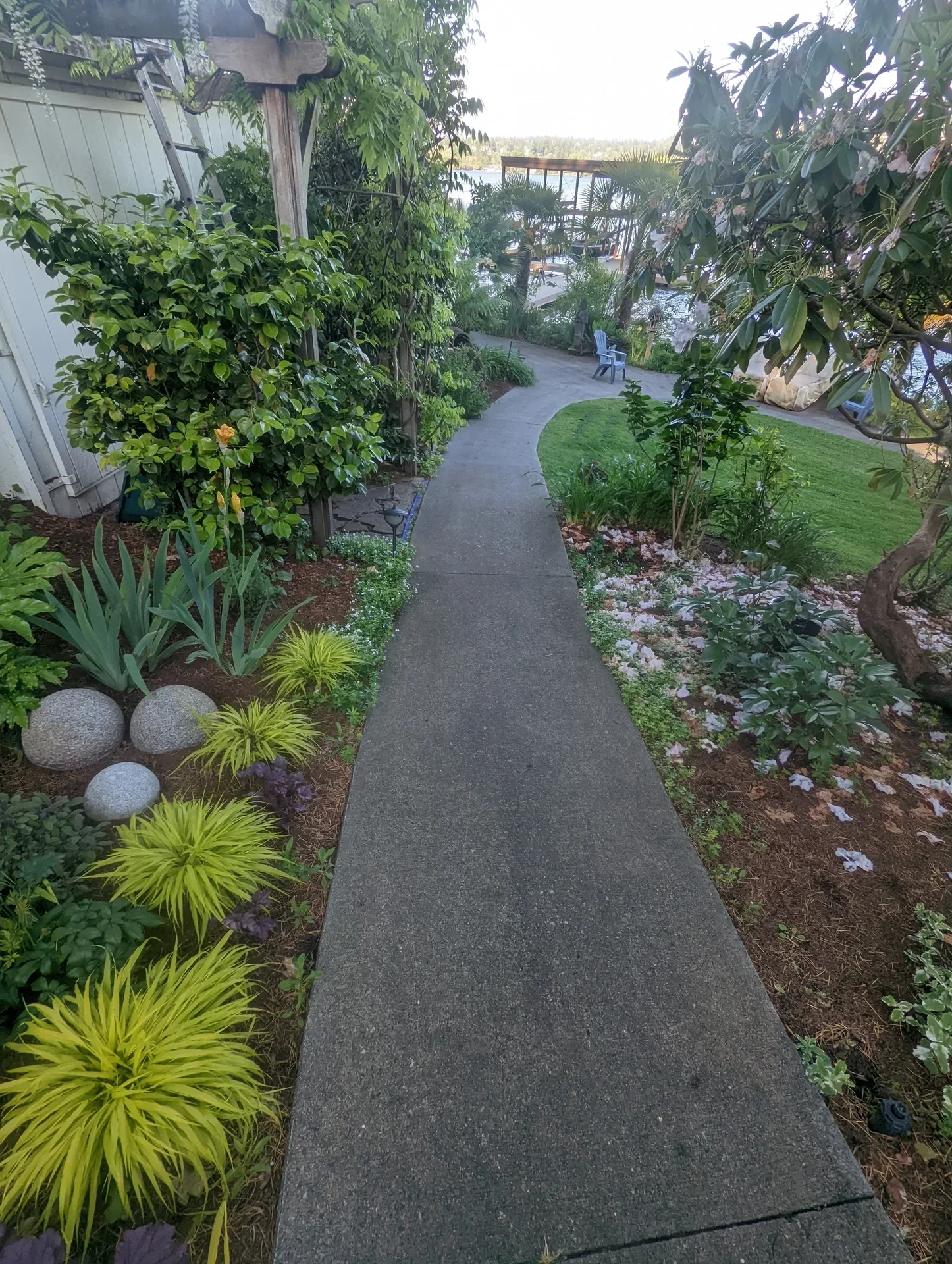
Xeriscaping in Seattle sounds like a contradiction until you look at the rainfall distribution. We get a long, wet winter and then a genuinely dry stretch from July into September when nothing falls for weeks. Planting chosen for both ends of that pattern stops needing intervention.
This is not gravel and cactus. A desert idiom looks wrong on a Puget Sound property and ages badly. Done for this region it means ornamental grasses, drought-tolerant perennials, and Mediterranean and native planting that reads full and soft for most of the year and simply does not care about August.
Where it earns its place
Open west and south-facing sites where lawn browns off every summer regardless of what you do.
Parking strips, which get full sun, reflected heat off the road, foot traffic, no irrigation and often a city restriction on what can go there.
Slopes where mowing is awkward, runoff is a problem and grass never establishes evenly.
Properties with a real water bill, or anybody who would rather not run irrigation through a dry spell at all.
How it is built
The planting is only half of it. The other half is the ground.
- Soil prepared for drainage rather than for moisture retention. Most drought-tolerant planting dies of winter wet here, not summer drought. Getting water away in January is what keeps it alive.
- Grading and swales that slow runoff and let it soak where it is useful.
- Mineral mulch where the planting style suits it, holding moisture without the nitrogen draw of a decomposing bark layer.
- Boulders and stone to anchor a scheme and hold a slope.
- Drip irrigation for establishment, run for the first two summers and then dialled back or removed once roots are down.
What goes in
Ornamental grasses for movement and winter structure. Drought-tolerant perennials with a long flower season. Evergreen shrubs that carry the scheme through February. Natives that handle both a saturated winter and a rainless August without a second thought.
The result is a landscape that looks intentional in January and still looks alive in late August, which is better than most lawns in this city manage.
Common questions
Does xeriscaping make sense in a rainy city?
Yes, because the rain is seasonal. Seattle gets a long wet winter and a genuinely dry stretch from July into September. Planting that handles both ends without irrigation is doing real work.
Does it mean gravel and cactus?
No. That is a desert idiom and it looks wrong here. Done for this region it means grasses, drought-tolerant perennials and Mediterranean or native planting, which reads lush for most of the year.
Will it still need water?
Through the first two summers, yes, while roots establish. After that most of it manages on rainfall in an ordinary year.
Where does it work best?
Open, west or south-facing sites. Parking strips. Slopes where a mower is a nuisance and a lawn browns off every August anyway.