
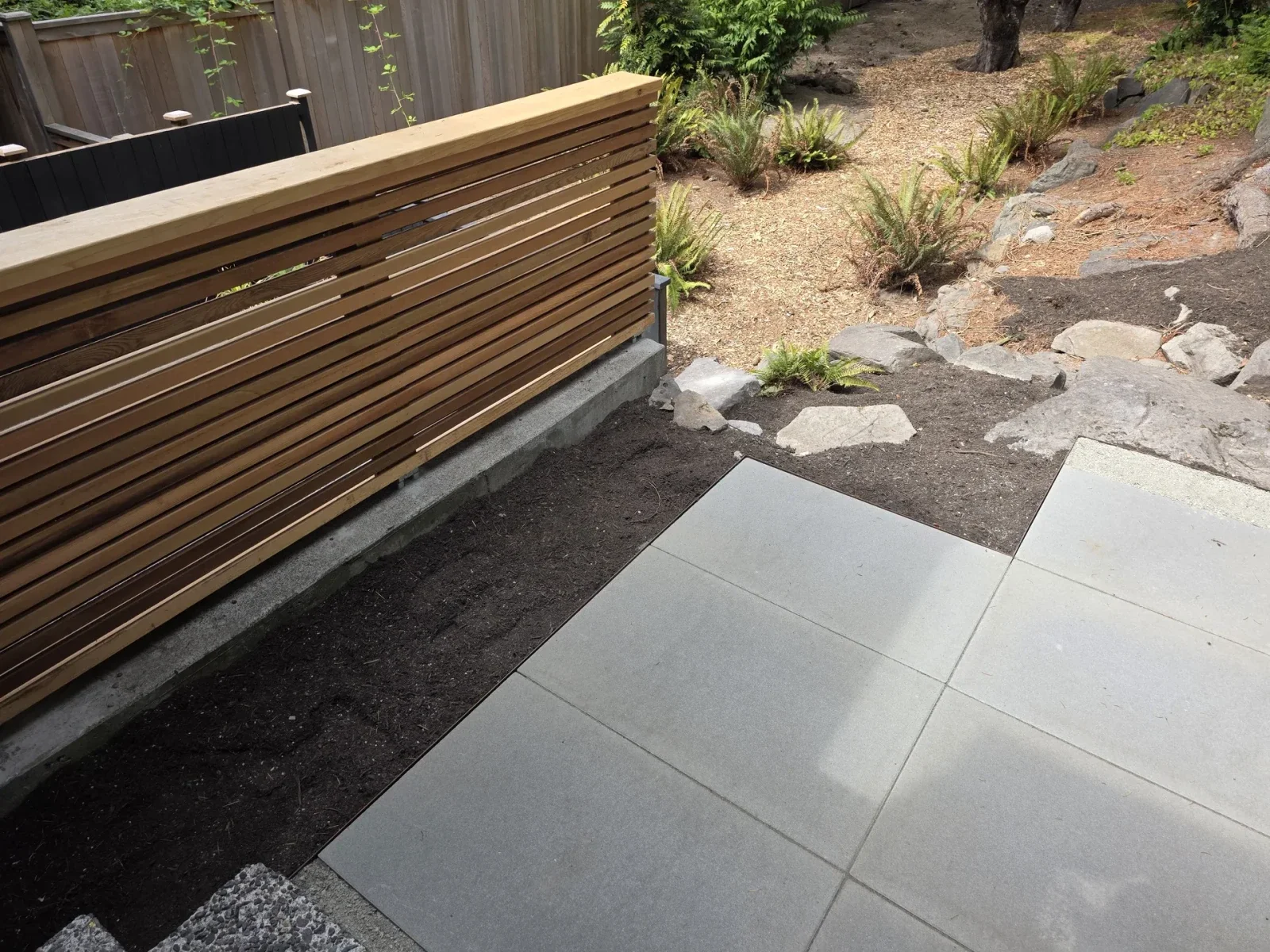
Seattle lots sit close together and a great many of them slope. Those two facts decide almost everything about a fence here: privacy counts for far in a way it does not on a larger lot, and the ground under the fence line is rarely level.
Ground that stays wet
The reason fences fail in this climate is almost always the post. A post set in a solid concrete collar with nowhere for water to go is sitting in a bucket for five months of the year, and it rots from the base.
We set posts on a gravel base so water can drain away from the timber, with the collar shaped to shed water rather than pond against the post. It is a small detail at install and it is the difference between a fence at fifteen years and a fence at seven.
Stepped to the grade
On a sloping boundary a fence either steps down in panel-sized increments or rakes continuously with the ground. Stepped suits most Seattle lots and reads as deliberate. Raked suits a long, gentle slope. Either works, and the wrong one on the wrong site looks like a mistake from the street.
Materials that hold up here
Western red cedar. Locally sourced, naturally resistant to decay and insects, and it silvers nicely if you leave it. The default for good reason.
Composite. Higher upfront, no staining, and it holds its colour. Suits a contemporary property and anybody who does not want a maintenance commitment.
Wire-backed and post-and-rail. For boundaries where containment matters rather than screening, and for larger or more rural lots.
What we do
- New fence installation, including gates that stay square
- Panel replacement where the posts are still sound
- Post replacement and re-setting on failing runs
- Gate rebuilds and hardware replacement
- Fence lines set against surveyed boundaries rather than against the previous fence
A fence very often arrives alongside other work: a retaining wall holding the grade it sits on, or planting softening it from the inside.
Common questions
How tall can a fence be?
In most Seattle residential zones, six feet in a rear or side yard and lower in a front setback, with variations by jurisdiction and by lot. We check before quoting rather than after building.
Why do fence posts fail here?
Water. A post set in a solid concrete collar with no drainage sits in a bucket of water all winter. Posts need a gravel base so water can leave.
Stepped or raked on a slope?
Stepped on most Seattle lots, which suits panel construction and reads as deliberate. Raked follows the ground continuously and suits gentler, longer slopes.
Can you repair rather than replace?
Often yes. Where the posts are sound the panels can be replaced on their own, which costs a fraction of a full rebuild.